I've been kind of low key (okay, almost silent) about the fact that I researched and wrote a book with the working title Hiking Through History for the Appalachian Trail Conservancy. It's time I open up.
The fact is, I was waiting for the big "reveal." I was waiting for the book to materialize from its long metamorphosis from digital manuscript to bound form to validate me, as a historian, writer, author. I was waiting to ask for your support once it came out, to invite me to speak, purchase my book, and spread the word.
But I'm really excited for it, and I want to make it a reality, soon (as in edits finalized, layout complete, printed, and in your hands).
I just made my third presentation on the book. I've presented at UNCA-Asheville, the Madison County Geneological Society, and, tonight, the Franklin Library. I'm honing my presentation, and I'm owning the fact that I've written a book. I'm amped! I got home two hours ago, and I'm still running off the excitement of sharing the the Appalachian Trail and the history I discovered.
So, let's do this, shall we?
If you are interested or may ever be interested in my book, sign up with your interest here so I can demonstrate interest and support. Together: you, me, the Appalachian Trail Conservancy, we'll make this a reality.
Thanks,
Leanna
Thursday, September 27, 2012


Monday, September 24, 2012
Resupply: The Appalachian Trail v. The Pacific Crest Trail
The Appalachian Trail Versus the Pacific Crest Trail: How to Pick Your Pleasure, Part Four
They weren’t designated the first National Scenic Trails for
nothing. These two premier hiking trails are designed specifically to impart
the beauty of their landscapes (seriously, trail builders think of these
things).
Both are excellent choices, so whether you’ve finished
hiking one of them and are ready to take on the next, or are simply deciding
which one to hike for your first-ever thru-hike, here are some discernable differences
that make each unique.
Town Stops & Resupply: While this won’t make or break a decision to
hike one of these trails over the other, resupply is an important component of
a long-distance hike, and these two trails are really different when it comes
to resupply.
 |
| A hitch in Maine |
 |
| The long wait. The hitch into Mojave finally ended with a ride in the police car. Thankfully the patrolman looks out for hikers in need of a ride so they don't become casualties of the intense roadside heat. |
 |
| I got a hitch with these nice fellas near Wrightwood, CA. |
Even if hiking solo, hitchhiking to towns in pairs is the
safest approach. I take this precaution seriously as a female hiker. While it’s
not always possible to hitchhike with others, the fact that more people hike
the A.T. means that there are generally other hikers around when you get ready
to hitch to town, or back to the trail. In all cases, use your gut. If someone seems odd, by all means, find a reason to get out of taking them up on their offer for a ride ("Oh, I just remembered that I think I left my camera back at my last stop on the Trail...Gotta get it. Thanks anyway!")
Trail Guides: When planning and hiking, here are my recommendations on the best resources for each of these trails. I would use them in these combinations.
Pacific Crest Trail
Water report (I'm not sure about the future of this site as the person who compiled the information passed away in August. Hopefully another PCT enthusiast will undertake the effort in his absence.)
Appalachian Trail
Part One: People
Part Two: Elements
Part Three: Trail terrain, views, snow
Part Four: Resupply
Do you have experience with both of these trails? What do you think are the biggest differences?
Saturday, September 22, 2012
True or False: the A.T. is hard; the PCT is easy
The Appalachian Trail v. the Pacific Crest Trail: How to Pick Your Pleasure, part three
They weren’t designated the first National Scenic Trails for nothing. These two premier hiking trails are designed specifically to impart the beauty of their landscapes (seriously, trail builders think of these things).
Both are excellent choices, so whether you’ve finished hiking one of them and are ready to take on the next, or are simply deciding which one to hike for your first-ever thru-hike, here is one of several discernible differences that make each unique.
The Trail: I’m talking treadway or footpath here. Every A.T. hiker hears that PCT is so much easier to hike. Every PCT hiker hears that the A.T. is like walking through a green tunnel. So, let’s get all this out in the open.
 |
| Gradually graded Pacific Crest Trail in Southern California |
The A.T. is hard. The PCT is easy. These generalizations, like most, don’t tell the whole story. The Pacific Crest Trail is primarily more gently graded than the A.T., and this difference is most starkly apparent at the outset of a northbound thru-hike, whether you start at Campo, California, or Spring Mountain, Georgia. While most hikers intend to train for their hike (and some do) most set out on a trail having scrambled to organize the rest of their lives so they can leave to fulfill their dream, often starting out with good intentions but not a lot of strength in their “hiking legs.” Plus, it’s my opinion that there’s no better training for a thru-hike than a thru-hike, but that’s another post entirely.
The difference at these trails’ southern terminuses means you may be able to easily hike 15 to 20 miles on day one in California, where you may only be able to hike 6 or 8 in Georgia. The difference is elevation change and the grade of the trail, but to generalize and say all of the PCT is easier would be going too far and excludes other factors of a PCT hike.
The fact is the PCT through the Sierras is difficult, given the altitude, terrain, river crossings, and snow; it’s not always a cakewalk. In the same token, the A.T. isn’t always a steep ascent and steep descent; there are rolling meadows, riverside ambles, and ridgeline walks. They both have their unique challenges, so let’s not get crazy with generalizations.
Sure, you can hike longer mile days on the PCT with a bit less fatigue, but you also need to cover 400 more miles on that trail in a slightly shorter window of time than on the A.T. (2,180 on the A.T. vs. 2,600 on the PCT).
Green Tunnel v. Views for Miles: I like to think of the Appalachian Trail as an experience in minutia, all the small wonders that make up this grand spectacle of nature; this includes walking through fog-shrouded tunnels of rhododendron grown so tightly together that I feel like I’m walking through a fairy tale. There are amazing views to be had along the A.T. from rock outcroppings and mountain summits, but they are the special features of the Trail, not necessarily a daily requirement. If they were on the food pyramid, amazing views would be the decadent dessert that you get in moderation, while walking in the rest of the experience provides well-balanced nourishment.
 |
| See the whit blaze on the rock in the center? Yes, this is the Appalachian Trail in Pennsylvania. (I love to dispel the generalization that ALL of Penn. is like this though.) |
The PCT offers views for miles around. In fact from where you walk, you can often see the trail ahead snaking off into the distance. This has the potential to inspire as well as discourage you, especially if you are tired and know your destination is far beyond sight. From every place you stand, you can take ten amazing photographs, easily. The key in such an environment is to find awe in the landscape that is perpetually on display.
Because you can become desensitized to either the vast beauty laid out before you on the PCT, or the forest’s secret wonders and “special features” on the A.T., it’s best to steer clear of comparing the apples and oranges in this regard, and just accept them as designed.
Snow: As a Southerner the snow took me by surprise on the A.T. and the PCT, at different times and in different ways. Here’s how:
On the Appalachian Trail, assuming a start date before April, you will likely get snow. While other areas of the Southeast may see not one white flake, A.T. hikers will get a dusting, if not a dump, because of the elevation and the likelihood for the mountain tops to “catch” and stall the weather system. Hikers starting in February or March often get snow in Georgia, North Carolina, and Tennessee, most notably in the Great Smoky Mountains National Park. These spring snows are wet and heavy, and can come unexpectedly (like following several days of spring sunshine). Like any other time on the A.T. it’s important for hikers be aware of their condition and follow tips for preventing hypothermia.
 |
| I awoke to this snowfall the morning I walked into North Carolina. |
 |
| On the PCT |

My trepidation for traveling in snow without my ice axe (I needed it much sooner than I thought and had sent it much farther ahead), led me to make a penny wise, pound foolish mistake. My friend Morph and I skipped around snowy San Jacinto and Fuller Ridge to a section farther north because I didn't have an ice axe. I should have bought one at the outfitter and kept hiking. As it was we spent excessive time and money hiking a more northern section, then returned later to re-capture this missing section of the Trail.
This is part three of a four part series on the differences between these 2 trails:
Part One: People
Part Two: Elements
Part Three: Trail terrain, views, snow
Part Four: Resupply
Thursday, September 20, 2012
The Elements: Appalachian Trail v. Pacific Crest Trail, a Guide to Picking Your Pleasure, part two
They weren’t designated the first National Scenic Trails for nothing. These two premier hiking trails are designed specifically to impart the beauty of their landscapes (seriously, trail builders think of these things).
Both are excellent choices, so whether you’ve finished hiking one of them and are ready to take on the next, or are simply deciding which one to hike for your first-ever thru-hike, the elements comprise one of several discernible differences that make each trail unique.
The PCT is sandy and shifts beneath your feet. Yes, sandy sidehill slips out from under you along canyons; additionally, the ground may literally sway beneath you as you drift to sleep. If you aren’t accustomed to quakes before your PCT hike, you will develop a sense for them. I felt three earthquakes in two-months.
Wind: The A.T. doesn’t have anything on the PCT when it comes to wind. This PCT element is a force to be reckoned with. I read recommendations for wind shirts or jackets in Yogi's PCT planning guide, but I should have taken the advice more seriously, very seriously.
Fire: Gathering around a fire with friends is a primal and communal activity. It’s nostalgic, but it’s generally not practical on a thru-hike. After all, who wants to hike all day, and then collect firewood? But I’m writing more than just about campfires when I talk about fire. It relates to camp stoves, too.
If you like a hot meal, if you like gathering around a campfire, and if you like hot coffee on trail, the A.T. has a lot more to offer. Why? Because, as my friend Morph has said, the PCT is a tinderbox.
In 2012, there were 11 fires that effected or closed sections of the PCT. Given that conditions are drier in the west, coupled with the aforementioned wind, it can be dangerous and unwise to build campfires, and sometimes even cook a hot meal on what would otherwise be a safe camp stove. It’s your judgment call once you’re out on the trail, but I signed and took seriously a permit to hike on the PCT that said I would be responsible to pay for containment and clean-up of any fire I caused. Sometimes this meant giving up the option to warm my instant mashed potatoes.
Water: Call me a water angel because it seems that in the years I chose to thru-hike, water was abundant. I hiked the A.T. in the rainiest year on record, and the PCT in 2010 was experiencing a very wet spring. That being said, water resources are always more abundant on the A.T. than the PCT. There are long stretches of the PCT through the desert where natural sources can’t be relied upon; this generally requires hikers to carry more water for longer distances.
(More about my initial impressions on PCT elements are found on my Trail Journal site. Please excuse the typos, I haven't edited it since my transcriber originally posted it. Sometimes she just couldn't make out my scrawl.)
This is part two of a four part series on the differences between these trails:
Part One: People
Part Two: Elements
Part Three: Trail terrain, views, snow
Part Four: Resupply
Both are excellent choices, so whether you’ve finished hiking one of them and are ready to take on the next, or are simply deciding which one to hike for your first-ever thru-hike, the elements comprise one of several discernible differences that make each trail unique.
The Elements: The Appalachians and the Pacific Crest are different mountain ranges with distinct landscapes and climates that influence these elements: earth, wind, fire, and water.
Earth: On the A.T. the world beneath your feet is red clay, rocks, and roots (from Georgia up to the mid-Atlantic), or boggy and bedrock (in the northeast). As a 480 million year old mountain range, it's stable ground. |
| Bedrock of the White Mountains of New Hampshire |
The PCT is sandy and shifts beneath your feet. Yes, sandy sidehill slips out from under you along canyons; additionally, the ground may literally sway beneath you as you drift to sleep. If you aren’t accustomed to quakes before your PCT hike, you will develop a sense for them. I felt three earthquakes in two-months.
Wind: The A.T. doesn’t have anything on the PCT when it comes to wind. This PCT element is a force to be reckoned with. I read recommendations for wind shirts or jackets in Yogi's PCT planning guide, but I should have taken the advice more seriously, very seriously.
 |
| It's no wonder you hike in sight of windmills on the PCT. |
Fire: Gathering around a fire with friends is a primal and communal activity. It’s nostalgic, but it’s generally not practical on a thru-hike. After all, who wants to hike all day, and then collect firewood? But I’m writing more than just about campfires when I talk about fire. It relates to camp stoves, too.
If you like a hot meal, if you like gathering around a campfire, and if you like hot coffee on trail, the A.T. has a lot more to offer. Why? Because, as my friend Morph has said, the PCT is a tinderbox.
 |
| Burned forest. It's a frequent occurrence on the PCT. |
In 2012, there were 11 fires that effected or closed sections of the PCT. Given that conditions are drier in the west, coupled with the aforementioned wind, it can be dangerous and unwise to build campfires, and sometimes even cook a hot meal on what would otherwise be a safe camp stove. It’s your judgment call once you’re out on the trail, but I signed and took seriously a permit to hike on the PCT that said I would be responsible to pay for containment and clean-up of any fire I caused. Sometimes this meant giving up the option to warm my instant mashed potatoes.
Water: Call me a water angel because it seems that in the years I chose to thru-hike, water was abundant. I hiked the A.T. in the rainiest year on record, and the PCT in 2010 was experiencing a very wet spring. That being said, water resources are always more abundant on the A.T. than the PCT. There are long stretches of the PCT through the desert where natural sources can’t be relied upon; this generally requires hikers to carry more water for longer distances.
(More about my initial impressions on PCT elements are found on my Trail Journal site. Please excuse the typos, I haven't edited it since my transcriber originally posted it. Sometimes she just couldn't make out my scrawl.)
This is part two of a four part series on the differences between these trails:
Part One: People
Part Two: Elements
Part Three: Trail terrain, views, snow
Part Four: Resupply
Wednesday, September 19, 2012
Appalachian Trail v. Pacific Crest Trail: A Guide to Pick Your Hiking Pleasure, part one: People or Wilderness
They weren’t designated the first National Scenic Trails for nothing. These two premier hiking trails are designed specifically to impart the beauty of their landscapes. (Seriously, trail builders think of these things.)
On the A.T. shelters tends to organize hikers into condensed clumps, yes clumps, of hikers. If you stay at shelters or camp nearby them, you may hike alone all day, encountering some hikers along the way, but rest assured, you’ll get to swap stories over meals around the campfire before you snooze. It’s a perk for the extroverts among us, but can be overwhelming to people who came to seek fellowship with the wilderness, as the shelter environment can breed an almost party-like atmosphere, especially within the first 500-miles of the Trail.
On the PCT there are a few formalized campsites, and others that naturally develop around water sources. Without heavily established sites, hikers on the PCT tend to walk until they are ready to stop, rather than walk to an established “destination” for the day. Also, fewer people start thru-hikes of the PCT every year than on the A.T. Given these facts, if you start any time after the ADZPCTKO, you will encounter fewer hikers during the day and at night. It takes a bit more planning to camp with people you enjoy spending time with on the PCT given the low-impact nature of camping, especially if you like to hike alone much of the day.
 |
| I awoke to this sunrise after literally sleeping alone under rocks on the PCT. |
Both are excellent choices, so whether you’ve finished hiking one of them and are ready to take on the next, or are simply deciding which one to hike for your first-ever thru-hike, here is one of several discernible differences that make each unique.
This analysis is based on northbound thru-hikes of both trails. A southbound hike of the Appalachian Trail offers some distinctions from hiking Georgia to Maine that will offer a completely different experience. (I'm happy to discuss those differences with you.)
The People Factor: The Appalachian Trail has shelters and designated campsites along the way. The Pacific Crest Trail encourages distributed camping by not formalizing camps.
Here’s how it impacts your trip:
 |
| Lots of good people, many I still count as best friends, at Eagles Nest Shelter in Penn. in 2003. |
On the A.T. shelters tends to organize hikers into condensed clumps, yes clumps, of hikers. If you stay at shelters or camp nearby them, you may hike alone all day, encountering some hikers along the way, but rest assured, you’ll get to swap stories over meals around the campfire before you snooze. It’s a perk for the extroverts among us, but can be overwhelming to people who came to seek fellowship with the wilderness, as the shelter environment can breed an almost party-like atmosphere, especially within the first 500-miles of the Trail.
 |
| I slept alone under these rocks on May 4, 2010 as this spot afforded the most protection from the relentless wind. |
On the PCT there are a few formalized campsites, and others that naturally develop around water sources. Without heavily established sites, hikers on the PCT tend to walk until they are ready to stop, rather than walk to an established “destination” for the day. Also, fewer people start thru-hikes of the PCT every year than on the A.T. Given these facts, if you start any time after the ADZPCTKO, you will encounter fewer hikers during the day and at night. It takes a bit more planning to camp with people you enjoy spending time with on the PCT given the low-impact nature of camping, especially if you like to hike alone much of the day.
This is part one of a four part series on the differences between the PCT and the A.T. Tomorrow, I'll discuss the elements. Not the weather, but earth, wind, fire, and water. After that I'll cover terrain, snow, and resupply. If you have requests for other topics, please let me know.
Thursday, August 9, 2012
Everything I Need to Know about Life I Learned on the Appalachian Trail
I was listening to Krista Tippett’s On Being interview with Sarah Kay about the power of words, and Sarah explained an exercise she uses as a prompt when working with students to cultivate their self expression. (She used it in her TED talk, too.) The prompt is to answer this: What I know to be True.
When I thought about what I know to be true, it came to me that everything I ever needed to know I learned by hiking the Appalachian Trail, all 2,172 miles of it in six-and-a-half months. That is where this begins.
Life isn’t in 4 walls: It isn’t the house that surrounds us. It isn’t in the office where we spend the majority of our days, positioned behind a computer. It is outside in this vast compendium of earthliness – from the smallest critters, like ants, centipedes, and chipmunks – to the calm of a deer grazing without notice of your presence – to the fierce protection a mother grouse has of her nest – to the magic of a bear in his element, his home, not one constructed of four walls, with regular feeding time. The minutiae of the organisms in the dirt. The sun. Time spent in such regular contact with the moon, daily knowing her waxing and waning. By four walls, I also mean the constructs of our society that keep us chained to our “place,” items of imaginary importance – politics, war, violence, “trending” news – like celebrity marriages and children. Why is any of that more important than what we can witness and experience for ourselves, separated from all of that?
Appreciate everything: Seriously, if you can’t find reasons to be in love with something through endless days of rain, there isn’t a way you can complete a six-and-a-half month hike on the Appalachian Trail. Just like life, it has its highs and its lows (sometimes more lows). I couldn’t have completed my 2003 thru-hike during “the rainiest year on record” without a positive outlook, which sometimes meant creating things to be thankful for. Optimism, yes, positive outlook mixed with hope for good to come, goes a long way toward fulfillment.
I am everything. Everything is me: I grew up with Christian principles, and I learned this distinctly eastern philosophy through my direct experience in my 25th year on this planet. It’s hard to capture in a snappy paragraph, but it was hard-won knowledge that left me feeling more compassionate toward the earth and all her animals, including my fellow humans and myself.
I started to connect that if we treat the earth poorly, in our industrial food production systems, for instance, that it returns to us, with unhealthy food choices and unhealthy bodies. I reasoned that we don’t know our food any more. (This was prior to my familiarity with the slow food movement, Animal, Vegetable, Miracle or Omnivore’s Dilemma. I was still a conventional food consumer to the core before my hike, unaware of the food practices plaguing the natural seed banks of our nation.) I suspected that animals carved and sold to us in Styrofoam on things that look like maxi-pads to soak up the blood were part of our disconnect with what we ate. How could we appreciate our food when we didn’t know where it came from? If we couldn’t even bear to see the sight of its blood?
The food system is just one example of the awareness that bubbled up in me during my hike, of the connectivity of life and life cycles on this planet. I became more distinctly aware of my connection to my ancestors (then living and dead), to what impact my words, my “footsteps”, and my actions have on everything and everyone around me. I continue to learn this life lesson; it’s a big one.
The trail gives you what you need: It’s an expression that litters the trail, just like those silly little corners from granola bar and candy wrappers that tend to slip out of fingers or pant pockets (so watch you don’t loose yours). Experienced long-distance hikers dispense this nugget like yoga teachers spout ancient Sanskrit text or Christians throw around John 3:16. It is THE BIGGIE! But hearing it and living it are two different things. I learned it then, but must continually revive it for myself in my off-trail life – faith. It’s nothing but faith.
I started my hike with faith founded in my Lutheran upbringing and the idiom my momma dispensed “God doesn’t give you more than you can handle.” But before long I came to trust the expression of the trail delivering what I need much more, because the challenges were harder than anything I had faced before.
I had to trust that entering the heavy spring snow of the Great Smoky Mountains I wouldn’t die of exposure, and that I had the right gear and knowledge to stay safe. I had to trust that a wild animal wouldn’t carry off my food, and if it did I could survive. I had to trust that I wouldn’t get lost in an attempt to cross-country navigate in the 100-mile wilderness of Maine. I had to trust that despite walking through a sunken trail that resembled a river and endless days of mud that I wouldn’t develop trench foot or hypothermia. I had to trust that being scared out of my wits by an aggressive grouse was precisely what would be best for me at that moment. See, this phrase didn’t just say “you can handle it” it also went a step further to suggest that it’s necessary growth. It’s what you need.
And, while the trail gave me challenges and obstacles (like scaling vertical ladders on sheer rock faces of New England), it also gave me things like lakes for swimming on a few perfect, sunshiny days, flying a kite from a canoe, easy hitches into town with kind strangers, the soaking rain of a thunderstorm just after I arrived at a shelter, and friends showing up in unusual places. These things, too, were just what I needed, when I needed them.
What if we look at all of life as a perfect dose from the Universe of what we need, trusting that it will all work out? Faith, trust, hope – that’s about all we can do…Oh, and love.
There is no perfect time: There’s now. On my hike I encountered people who lamented not being able to go on a long hike. The secret, the hidden truth, I came to understand after a few conversations that started this way, is that hiking (or insert your dream here….) is accessible to all of us. Each of us can save a few thousand dollars to hike, find a way to jump off the ferris wheel of “life as we know it” and get on the trail. When we leave, things continue. The world doesn’t stop because we we aren’t there to attend meetings, answer the phone, or meet for drinks at the bar on Tuesday. Family, friends, employment, and house…all of it will be there when we come back. But there’s too much that’s fleeting in this life not to go now, especially if it is what you want. This goes for anything, writing a book (write!), dancing (dance!), learning to fly (get a lesson!). Don’t wait. There may never be a better time than right this instance!
Another way to say it: there is fear and the excuses bred by those fears, and there is doing. Please, for the lova’, be a doer! (Note: I reminding myself of this lesson again and again and again…preachin’ to me and you!)
_________________________________________
What do you know to be true?
(Sarah would challenge you to elaborate. Don’t write just one word, but explain what it is, where it comes from…Go! You have 2 minutes!)
When I thought about what I know to be true, it came to me that everything I ever needed to know I learned by hiking the Appalachian Trail, all 2,172 miles of it in six-and-a-half months. That is where this begins.
 |
| The end of the Trail, October 4, 2003. |
Appreciate everything: Seriously, if you can’t find reasons to be in love with something through endless days of rain, there isn’t a way you can complete a six-and-a-half month hike on the Appalachian Trail. Just like life, it has its highs and its lows (sometimes more lows). I couldn’t have completed my 2003 thru-hike during “the rainiest year on record” without a positive outlook, which sometimes meant creating things to be thankful for. Optimism, yes, positive outlook mixed with hope for good to come, goes a long way toward fulfillment.
I am everything. Everything is me: I grew up with Christian principles, and I learned this distinctly eastern philosophy through my direct experience in my 25th year on this planet. It’s hard to capture in a snappy paragraph, but it was hard-won knowledge that left me feeling more compassionate toward the earth and all her animals, including my fellow humans and myself.
I started to connect that if we treat the earth poorly, in our industrial food production systems, for instance, that it returns to us, with unhealthy food choices and unhealthy bodies. I reasoned that we don’t know our food any more. (This was prior to my familiarity with the slow food movement, Animal, Vegetable, Miracle or Omnivore’s Dilemma. I was still a conventional food consumer to the core before my hike, unaware of the food practices plaguing the natural seed banks of our nation.) I suspected that animals carved and sold to us in Styrofoam on things that look like maxi-pads to soak up the blood were part of our disconnect with what we ate. How could we appreciate our food when we didn’t know where it came from? If we couldn’t even bear to see the sight of its blood?
The food system is just one example of the awareness that bubbled up in me during my hike, of the connectivity of life and life cycles on this planet. I became more distinctly aware of my connection to my ancestors (then living and dead), to what impact my words, my “footsteps”, and my actions have on everything and everyone around me. I continue to learn this life lesson; it’s a big one.
The trail gives you what you need: It’s an expression that litters the trail, just like those silly little corners from granola bar and candy wrappers that tend to slip out of fingers or pant pockets (so watch you don’t loose yours). Experienced long-distance hikers dispense this nugget like yoga teachers spout ancient Sanskrit text or Christians throw around John 3:16. It is THE BIGGIE! But hearing it and living it are two different things. I learned it then, but must continually revive it for myself in my off-trail life – faith. It’s nothing but faith.
I started my hike with faith founded in my Lutheran upbringing and the idiom my momma dispensed “God doesn’t give you more than you can handle.” But before long I came to trust the expression of the trail delivering what I need much more, because the challenges were harder than anything I had faced before.
I had to trust that entering the heavy spring snow of the Great Smoky Mountains I wouldn’t die of exposure, and that I had the right gear and knowledge to stay safe. I had to trust that a wild animal wouldn’t carry off my food, and if it did I could survive. I had to trust that I wouldn’t get lost in an attempt to cross-country navigate in the 100-mile wilderness of Maine. I had to trust that despite walking through a sunken trail that resembled a river and endless days of mud that I wouldn’t develop trench foot or hypothermia. I had to trust that being scared out of my wits by an aggressive grouse was precisely what would be best for me at that moment. See, this phrase didn’t just say “you can handle it” it also went a step further to suggest that it’s necessary growth. It’s what you need.
And, while the trail gave me challenges and obstacles (like scaling vertical ladders on sheer rock faces of New England), it also gave me things like lakes for swimming on a few perfect, sunshiny days, flying a kite from a canoe, easy hitches into town with kind strangers, the soaking rain of a thunderstorm just after I arrived at a shelter, and friends showing up in unusual places. These things, too, were just what I needed, when I needed them.
What if we look at all of life as a perfect dose from the Universe of what we need, trusting that it will all work out? Faith, trust, hope – that’s about all we can do…Oh, and love.
There is no perfect time: There’s now. On my hike I encountered people who lamented not being able to go on a long hike. The secret, the hidden truth, I came to understand after a few conversations that started this way, is that hiking (or insert your dream here….) is accessible to all of us. Each of us can save a few thousand dollars to hike, find a way to jump off the ferris wheel of “life as we know it” and get on the trail. When we leave, things continue. The world doesn’t stop because we we aren’t there to attend meetings, answer the phone, or meet for drinks at the bar on Tuesday. Family, friends, employment, and house…all of it will be there when we come back. But there’s too much that’s fleeting in this life not to go now, especially if it is what you want. This goes for anything, writing a book (write!), dancing (dance!), learning to fly (get a lesson!). Don’t wait. There may never be a better time than right this instance!
Another way to say it: there is fear and the excuses bred by those fears, and there is doing. Please, for the lova’, be a doer! (Note: I reminding myself of this lesson again and again and again…preachin’ to me and you!)
_________________________________________
What do you know to be true?
(Sarah would challenge you to elaborate. Don’t write just one word, but explain what it is, where it comes from…Go! You have 2 minutes!)
Monday, June 11, 2012
Havin' Fun, Hon
-->

Christina and I met when I lived in Northern Virginia and DC a little over ten years ago. I'm so appreciative for our lasting friendship, and the opportunities I get to visit and reconnect with her.
I arrived at the Christina and Rob’s home Thursday and with enough
vespers of daylight left for Christina and I to take Chapman for a walk through
the neighborhood. That evening I checked a couple books out of the Swanwick
lending library, including Musicophilia that explores how music interacts with
our brains.
Friday morning while they took care of a few household
matters and work meetings, I took a run on the C&O Canal. I chatted up a neighbor on the return portion of my run because we were both out enjoying the beautiful day. By mid-day Rob
and I escaped the vortex of the city traffic and high-tailed it to Annapolis in
my zippy little 5-speed. Christina still had work to finish up before she could
join us.
Once we got to the dock, Rob still had more work to do.
Luckily, I’m an easy-to-entertain guest. I lounged on the boat's deck reading
Musicophilia and dozing off between pages as my body grew accustomed to the
gentle rocking of life on a boat.
Once Christina and Chapman arrived, we gathered up and
discussed anchoring out for the night. Rob described this to me as a camping
experience; as an avid backpacker, I’m all for something akin to camping. In
this case, we have all the perks their Hunter 356 including a kitchen, head (that's a toilet),
cushions, beds, and gorgeous Chesapeake Bay scenery – all of which are far more
than I generally get camping.
Before long we were ready to set out for a sail around the
bay. I had one task as we pushed off from the dock. I was to hold the dock
rope, then toss it back onto the dock when I was told. Giddy with my role, I
sat on the edge of the boat, and awaited the sign. As we pulled away there was
a skidding sound of plastic across the fiberglass of the deck and a plop in the
water. Momentarily, I realized it was my camera sinking low and sending up
farewell bubbles to me. It had slipped out of my opened pocket as I leaned and
tossed the rope. I held my composure and gave an “all things must pass” Zen
“oh, well” to its disappearance feeling thankful that I had at least retrieved
my most recent photos from hiking the Foothills Trail.
 |
| Sailing the bay with Rob and Christina |
We sailed the Bay. I learned about crab traps and buoys, and
I watched Christina and Rob function as a familiar team to orient us through
the obstacles. The weather seemed perfect for our
cruise. We turned back a bit, then
pointed course up the Severn River, ducked under two bridges, then tacked
ourselves into a deceptively deep creek to tie up to Carl & Audry’s twin
boat already on a mooring ball.
We enjoyed great conversation, drank a splash of wine, and
watched Rob’s Olympic rowing in the dingy to diligently collect a record number
of cans floating from up the creek, from what we presume was a last-day of school
party for high schoolers since it was all Miller Light.
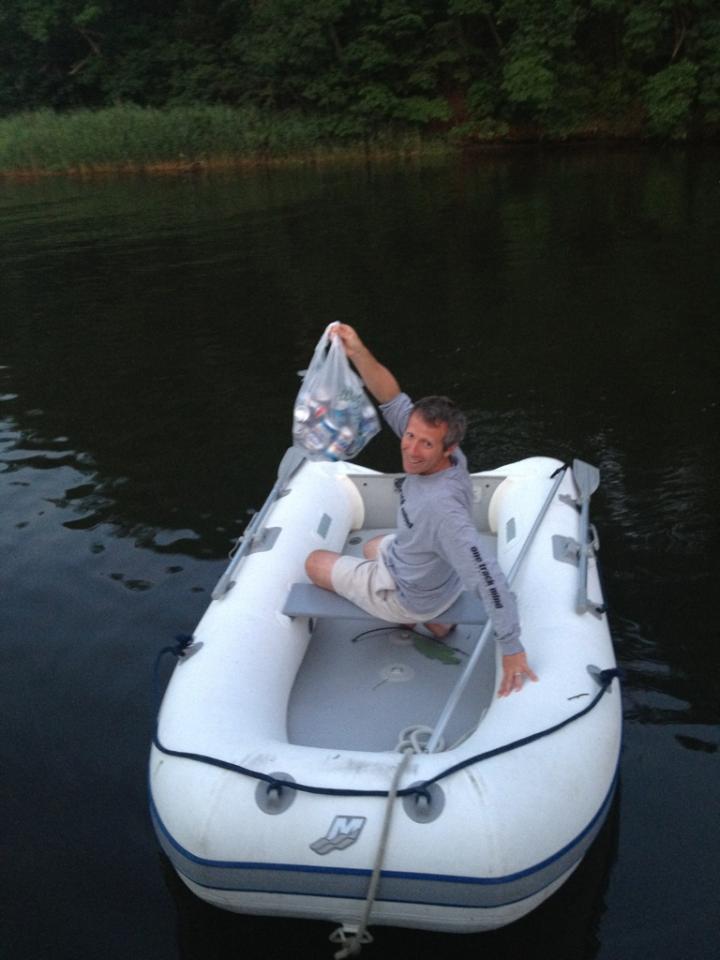 |
| The collective sum of his litter pick-up efforts. |
Like camping, the sun rose in our little creek cove, and we
scrambled up to the deck to take in the day. Over breakfast and coffee Audry,
Carl, Rob and Christina strategized a trip to Baltimore (I learned hometown locals
call it “Bawlmer”) to the HonFest – a celebration of all things
Hairspray-inspired: beehives, 60s fashion – from sweet dresses to spandex and
bright blue eye-shadow.
 |
| Me, Aubry, Rob and Carl just arriving at the festival. |
“Hon” is a term of endearment. Short for “honey.” I found that you can’t
help but get in the spirit of starting or ending all your exclamations with it,
especially after you witness the spectacle of the festival. I felt at home in
Hampden, the neighborhood that hosted the party. It felt like an Asheville
street festival full of personality, wigs, costumes, and flamboyance.

We
wandered and sauntered. I felt a
bit under dressed for the occasion given all the spirit, but later Carl, Rob,
Audry and I made up for plain clothes by trying out our mash potato skills in
front of the main stage. Christina did her best to pretend she wasn’t with us.
 | |
| Carl and I warming up our Mash Potato skills in the restaurant. |
 |
| Later, we applied our dancing skills at the stage! |
When we got back to Annapolis, I got a personalized drive
through town from Carl who said it’s the only state capital with a wood dome.
Rob, Christina and I walked back into town, stopping at the Fleet Reserve Club
for a few quick rounds of shuffleboard (I think I gave them more competition than they expected) before eating an amazing sushi dinner
and returning to the marina.
Sunday morning Christina and I woke early and took a run
through Annapolis then returned to the marina for a triathlon-like feat of
endurance (ok, at least for me) by swimming laps in the pool. Christina was
practicing her newly acquired skills for improving her swim-breath, and I was
goofing off as much as possible as I thought of breakfast and cups of coffee in
my future.
I had to bid adieu to my awesome hosts and new friends in
Carl and Audry by mid-morning Sunday so I could make the long drive back to
Asheville. The drive was easy, the radio entertaining, and my mind occupied
with rerunning all weekend’s events with good friends. Until we Swan Around
again, take care, Hon!
Subscribe to:
Posts (Atom)